
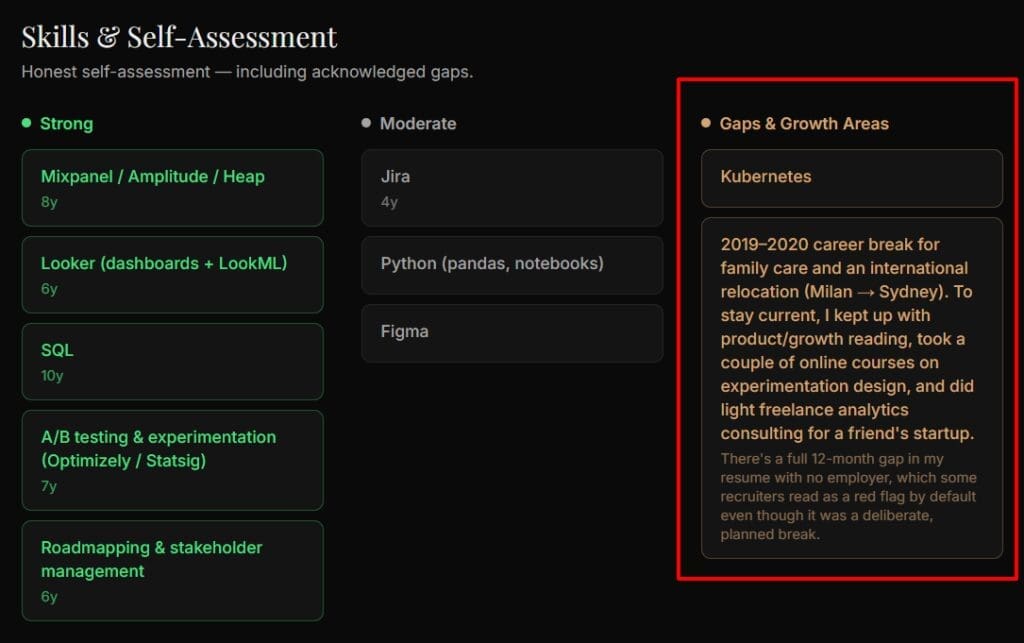
A gap skill is something you want to grow in but are not strong at yet. The Skills tab calls it a skill marked "Still developing", filed in the third column of the Skills matrix.
Profiled requires at least one before you can publish, because a profile claiming no weaknesses reads as either inexperienced or curated, and the AI cannot speak honestly about gaps it was never told about.
Detail
Where it lives. The Skills tab is a matrix with three columns: Strong, Moderate and Still developing. A still-developing skill is simply a skill card in the third column.

After adding a still-developing skill, you can expand the card to add more details. This helps Profiled’s AI better inform recruiters and hiring managers who may query the skill further.

Note: This is not the same as the Gaps tab. The Skills matrix handles specific skills; the Gaps tab handles broader experience gaps, e.g., "never managed a team", "no regulated-industry exposure". Both have their own publish check and they are satisfied separately. Filling one does not satisfy the other.

Why the requirement exists. The fit assessment is built to be honest rather than flattering, and honesty needs substance. When a recruiter or hiring manager pastes a job description into your profile, the assessment weighs what you have against what the role wants, including where you fall short. A profile with nothing in the "Still developing" column forces the AI to either stay vague or infer weaknesses it has no basis for.
Does admitting gaps hurt you? It is the opposite of what most candidates expect, and it is the whole thesis of what Profiled is all about: a named gap with a reason reads as self-aware, while an unbroken wall of strengths reads as marketing. Recruiters and hiring managers using Profiled are choosing it precisely because it does not flatter.
Choosing one honestly. Pick something genuinely adjacent to your work that you would want to develop, not a token weakness, and not something central to the roles you are targeting. The "Interested in learning this" checkbox on Gaps-tab entries lets you signal intent alongside the admission.
Related
- Why won’t the Publish button enable?
- How honest should I be about gaps — doesn’t that hurt me?
- What are the nine profile tabs, and do I have to fill them all?
Last verified: 2026-10-21