
Nobody else sees them. They are never rendered on your public profile, and they are never given to the visitor chat at all. They are used by your Honest Fit Assessment, the tool a recruiter or hiring manager uses when they paste a job description against your profile. The profile assistant also reads them while it helps you write them, and shows them only to you.
To access the private experience fields, navigate to the ‘Experience’ tab in your profile and expand a card to view its details.
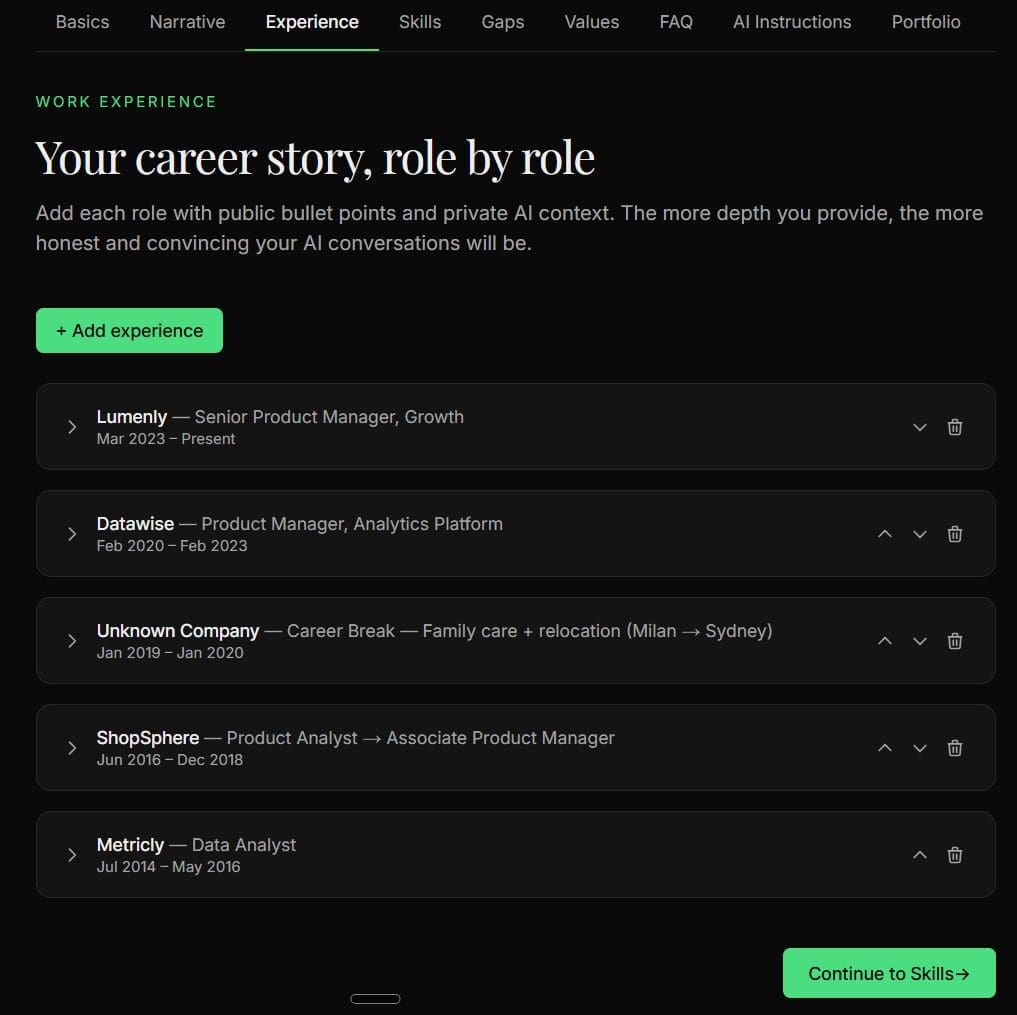
The Experience tab helps you build a career narrative that recruiters and hiring managers can query and explore to determine if you are a strong fit and a likely candidate for the role they seek to fill.
Click on an Experience card to expand it, then scroll down the card to the "Private AI context" section.

The Experience Tab
The eleven fields, discussed in more detail below, allow you to expand privately on each role, and cover the following: why you joined, why you left, actual contributions, proudest achievement, would do differently, challenges faced, lessons learned, what your manager would say, what your reports would say, conflicts and tensions, and quantified impact.
The split that matters. Each role has a public half (company, title, title progression, dates, accomplishment bullets), and a private half. The public half is what visitors read and what the chat can discuss. The private half is never shown to visitors or recruiters.
Why write them at all. Fit assessments are only as specific as their input. A role with a title and three bullets gives the assessment almost nothing to reason with.
"Why you left", "Would do differently" and "Quantified impact" are the highest-leverage three; they carry the judgment and the numbers that a résumé line cannot.
They also gate publishing. At least one role needs a company name, a job title and two or more private fields filled. That is the Experience depth gate, one of the five gates explained in Why won’t the Publish button enable?
They count toward your quality score too, by a different rule. A role counts for the score once it has a company name, a job title and at least one private field filled. Every private field counts the same, and three such roles earn the full 25 points for the tab. So one private field is enough for a role to score, but the gate needs two on the same role. Tab 3 — Experience covers the rest of the tab.
If writing them feels exposed, the AI Activity page in the sidebar is the reassurance: it shows every question visitors have asked your profile’s AI and the most recent fit assessments run against it, so you can see exactly what your profile is being measured against.
The 11 Private Fields: A Practical Guide
For Profiled candidates building their career narrative.
Before You Start
Every role you add to your Profiled experience section has 11 private fields attached to it. They work differently from everything else on your profile, and understanding that difference is what makes them worth filling in properly.
Private fields are never published. They don’t appear on your public profile. They are never given to the visitor chat. They are used by the Honest Fit Assessment, to give it the depth it needs when a recruiter evaluates you against a specific role. The profile assistant also reads them while it helps you write them, and shows them only to you.
This changes what you should write. A résumé is a public document, so you write it defensively. These fields aren’t, so you can write them the way you’d talk to a trusted mentor: candidly, specifically, and without the polish.
As you work through this section, hold onto these three things:
- Fit assessments are only as specific as their input. Vague fields produce vague verdicts. If the assessment can’t find evidence, it can’t make your case.
- Honesty is the mechanism, not a virtue signal. The assessment is built to be believed, which means it has to be willing to return "Probably not your person." Inflated input corrupts that, and a hiring manager who probes an inflated claim in an interview will find the gap fast. What survives scrutiny is what actually helps you.
- Three fields tend to be the most useful to an assessment: why you left, would do differently, and quantified impact. These hold the judgment and the numbers a résumé line can’t. For the quality score and the publishing gate, every private field counts the same. If you only have energy for a few, start there.
You need at least one role with a company name, a job title and two or more private fields filled before you can publish. Treat this as the floor, not the goal.
A note on the examples below. They follow one fictional candidate, Maya, a senior operations manager at a logistics company, so you can see how the fields build on each other. A second short example follows some fields for a career changer. Adapt the shape, not the words.
1. Why You Joined

What this field is for
The reasoning behind a career move, captured at the moment you made it. Not the job description you accepted, but what drew you to it: the problem you wanted to solve, the skill you wanted to build, the bet you were making.
Why it matters
Motivation is the signal that turns a list of jobs into a trajectory. A hiring manager reading your résumé sees four companies and has to guess whether you were drifting or steering. This field answers that directly, and it gives the fit assessment something to work with when a new role asks for people who are genuinely motivated by a particular kind of problem.
Where honesty earns its keep
You don’t have to pretend every move was strategic. "I needed to leave my previous role and this was a reasonable option" is a legitimate answer, and pairing it with what you then made of the opportunity is more credible than inventing a grand plan. Recruiters have heard the polished version a thousand times.
How it helps you land the role
When a job description describes a challenge that matches something you’ve actively sought out before, the assessment can connect them. That’s the difference between "has relevant experience" and "has deliberately chosen this kind of work twice."
Template
I joined [company] because [the specific draw: the problem, the stage, the skill, the person]. At the time I was [your situation and what you were optimizing for]. What made it worth it was [the concrete opportunity you saw].
Optimized example
I joined Northbridge Logistics because their warehouse operation was scaling faster than their systems could handle and nobody owned the problem end to end. I’d spent three years at a company where processes were already mature and I wanted to find out whether I could build them rather than just run them. The head of operations was explicit in the interview that the role came with real authority over process design, which is what sold me. I also took a slight pay cut to do it, which tells you how much the scope mattered to me.
Common mistakes
- Reciting the company’s marketing copy back ("I was excited by their mission to revolutionize…").
- Leaving out the practical factors. Money, location, and timing are real, and naming them makes the rest of your answer more believable.
2. Why You Left
One of the three highest-leverage fields.

What this field is for
The honest reason a role ended, in the detail you’d give a trusted colleague and not the version you’d give an interviewer.
Why it matters
This is the question every hiring manager has and almost nobody gets a straight answer to. Departures carry information: what you won’t tolerate, what you outgrew, what you learned about the environment you need. That information is directly relevant to whether you’d thrive in their role.
Where honesty earns its keep
This is the field most people are tempted to sanitize, and sanitizing it costs you the most. "Seeking new challenges" tells the assessment nothing, so it passes nothing on to the recruiter. Meanwhile the real reason, whether it’s a reorg, a manager you couldn’t work with, a role that stopped growing, or a layoff, is usually far more understandable than candidates assume.
Since this is private, you can be specific about difficult circumstances without broadcasting them. If you were let go, say so and say what you understand about why. A candid account of a layoff reads as self-aware. A vague one reads as evasive, which is worse than the layoff.
How it helps you land the role
When a role offers exactly what you left to find, that can inform the assessment’s judgment of the fit, without your reason for leaving ever being shown. That’s a fit signal no keyword match will ever produce. It also steers you away from environments that resemble the one you left, which saves you from a bad hire in both directions.
Template
I left because [the actual trigger]. [Context: what changed, or what had been building]. What I took from it is [what you now know you need or won’t accept].
Optimized example
I left after a reorg put the warehouse systems work under a newly hired VP who wanted to outsource the whole function to a vendor platform. I disagreed with the call and said so, and once the decision was final my role was essentially reduced to managing the vendor relationship. I stayed eight months to see the migration through properly, then started looking. It wasn’t acrimonious, and my old manager is a reference. What I learned is that I need to be somewhere that treats operations as a capability to build rather than a cost to outsource.
Career changer example
I left teaching after nine years because I’d started doing instructional design work for the district’s online program and realized I preferred it to classroom teaching. It wasn’t burnout, though the workload was real. I’d built three courses and found the design work more interesting than the delivery. I left to pursue it properly rather than keep doing it as an unofficial add-on to a full teaching load.
Common mistakes
- Non-answers: "for a new opportunity," "to pursue growth."
- Blaming without analysis. "My manager was terrible" is fine if you follow it with what specifically didn’t work and what you’d want instead.
3. Actual Contributions

What this field is for
What you personally did, separated from what your team, department or company did. The honest version of a line that a résumé would state as though you did it alone.
Why it matters
Résumés systematically blur ownership, and everyone knows it, which is why claims get discounted. Precisely scoped contributions read as credible and make your real ownership stand out.
Where honesty earns its keep
Say what was yours and what wasn’t. "I led the rollout but the technical architecture was the platform team’s" costs you nothing and makes the part you did own believable. Overclaiming is the fastest way to fail an interview, because the follow-up questions go one layer deeper than the claim, and if you weren’t there you can’t answer them.
How it helps you land the role
Fit assessments match capability to requirement. If a role needs someone who has personally owned vendor negotiation, a precisely scoped account of exactly that is strong evidence. A blurry "managed vendor relationships" is not.
Template
I personally [specific actions and decisions]. [What was collaborative and who did what]. [What was outside my scope]. The parts I owned end to end were [list].
Optimized example
I owned the warehouse process redesign end to end: current-state mapping, the new picking workflow, the pilot design, and the rollout across four sites. The WMS configuration itself was done by our systems analyst working to specifications I wrote. I didn’t own the budget; my director approved the spend, though I built the business case that got it approved. Change management across the floor teams was shared with the site supervisors, who ran the training while I wrote the materials and handled the escalations. What was unambiguously mine: the workflow design, the business case, the pilot, and the decision to sequence the rollout by site readiness rather than all at once.
Common mistakes
- Using "we" throughout. If the field can’t tell what you did, neither can the assessment.
- Deflating your role out of modesty. Precise is the goal, not small.
4. Proudest Achievement

What this field is for
The single thing from this role you’d most want understood, and why it meant something to you.
Why it matters
What you’re proud of reveals what you value. Two operations managers might both cite a project; one is proud of the cost saving, the other of the fact that nobody had to be let go. Those are different professionals, and hiring managers care about the difference.
Where honesty earns its keep
Pick what you’re actually proud of, not what you think sounds most impressive. Sometimes the honest answer is small in scale and large in difficulty: a relationship you repaired, a process nobody noticed because it finally worked, a person you developed. Those are often more revealing than the big number.
How it helps you land the role
It’s an interview hook. A specific, well-explained achievement gives your fit assessments something concrete to point to, and you arrive already prepared to talk about your best work. Recruiters never see this field; if you want them to read about the achievement, add a public version to the role’s "Key accomplishments". It also surfaces the qualitative strengths, judgment, persistence, care for the team, that a skills list can’t hold.
Template
[What you achieved, concretely]. It mattered because [why it was hard, or what was at stake]. What I’m proudest of specifically is [the part that was genuinely difficult or that reflects how you work].
Optimized example
Cutting the mis-pick rate from 4.1% to 0.8% across four sites in seven months. The number matters, but what I’m proudest of is that we got there without adding headcount and without the floor teams feeling like the change was done to them. The previous attempt at this had failed because it was designed centrally and handed down. I spent the first six weeks working shifts alongside the pickers before designing anything, and three of the changes that mattered most came directly from them. Two years later the rate is still under 1%, which tells me it stuck because they owned it.
Common mistakes
- Choosing the biggest number rather than the most meaningful work.
- Stating the achievement without explaining what made it hard. Difficulty is the part that carries the signal.
5. Would Do Differently
One of the three highest-leverage fields.

What this field is for
The decision you’d reverse, the approach you’d change, the thing you now see you got wrong.
Why it matters
This is where professional judgment becomes visible. Anyone can describe a success. Someone who can precisely articulate what they’d change demonstrates that they process experience rather than just accumulate it, and that’s a strong predictor of how fast they’ll improve in a new role.
Where honesty earns its keep
The temptation is the interview-safe non-answer: "I’d have communicated more." That is useless. Name a real decision with real consequences. The field is private, so the risk is far lower than it feels, and the payoff is high because so few candidates can do this convincingly.
How it helps you land the role
Hiring managers are wary of senior candidates who present as flawless, because it usually means low self-awareness. A candidate who can say "I underestimated X and here’s what it cost, and here’s what I’d do now" reads as safe to hire and easy to work with. It also proves you’d bring the lesson, not just the experience.
Template
I’d [the specific different choice]. At the time I [what you did and the reasoning]. What it cost was [the actual consequence]. Now I’d [the changed approach], because [what you understand differently].
Optimized example
I’d have run the pilot at the hardest site instead of the easiest one. I picked our best-run warehouse because I wanted a clean proof of concept, and I got one, but it told me almost nothing about how the workflow would hold up under real constraints. When we rolled out to the Dandenong site, which has older racking and higher staff turnover, we hit three problems the pilot couldn’t have surfaced, and it added about six weeks. A clean pilot is a comfortable pilot. I’d now test where it’s most likely to break, take the messier result, and build for it from the start.
Common mistakes
- Humblebrags disguised as regrets ("I’d have been less of a perfectionist").
- Regrets with no consequence attached. If nothing went wrong, it isn’t a lesson.
6. Challenges Faced

What this field is for
The genuine obstacles in this role: the constraints, the politics, the resource gaps, the things that made the work hard.
Why it matters
Context is what makes an achievement legible. Reducing costs by 15% with a full team and executive backing is a different accomplishment from doing it during a hiring freeze with a skeptical leadership team. Without the constraints, your results get read at face value and usually undervalued.
Where honesty earns its keep
Describe the difficulty as it actually was, including the parts that were uncomfortable or unresolved. You can be candid about organizational dysfunction here in a way you never could publicly. Just describe it analytically rather than bitterly: what the constraint was, how it affected the work, what you did about it.
How it helps you land the role
Many roles are explicitly hard: turnarounds, under-resourced teams, rebuilding after a failure. When a job description hints at that, evidence that you’ve operated in similar conditions is enormously valuable and almost impossible to demonstrate from a résumé.
Template
The main constraints were [specific: budget, headcount, politics, legacy systems, timeline]. [How each affected the work]. [What was outside my control]. The hardest part was [the genuine difficulty], which I handled by [your approach], with mixed results in [where it didn’t fully work].
Optimized example
Three things made it hard. First, a hiring freeze started two months in, so the two analysts I’d been promised never arrived and I did the data work myself on nights and weekends for a stretch. Second, the previous attempt at process redesign had failed publicly, so the floor teams were openly cynical and I had to earn credibility before anyone would engage. Third, our WMS was a heavily customized ten-year-old installation, and about a third of what I wanted to do wasn’t technically possible without a migration I couldn’t get funded. I worked around the last one by redesigning the physical workflow rather than the system logic, which got most of the benefit. It’s not what I’d have chosen with a clean slate.
Common mistakes
- Listing challenges without saying how you responded.
- Venting. Describe the constraint and your response, not the villain.
7. Lessons Learned

What this field is for
What this role taught you that you carried forward. Not what went wrong, that’s field 5, but what you now know.
Why it matters
It shows what you’d bring to the next role beyond the skills line. Lessons are portable in a way that role-specific experience isn’t, which makes this field particularly powerful for career changers and anyone moving between industries.
Where honesty earns its keep
The real lessons are usually specific and slightly uncomfortable: something about your own tendencies, a belief you had to abandon, a method that didn’t survive contact with reality. Generic lessons ("teamwork is important") signal that you haven’t reflected much.
How it helps you land the role
When a role’s challenges resemble something you’ve already learned from, the assessment can connect them explicitly. It also gives you strong, ready-made interview material, because "what did you learn from that?" is asked in nearly every senior interview.
Template
The main thing I learned is [the specific insight]. I’d previously assumed [the belief you held], and [what changed it]. I now [how you actually work differently as a result].
Optimized example
I learned that operational change fails on trust long before it fails on design. I came in believing that a well-designed process would sell itself to the people running it, because that had been true at my previous company where the team was already bought in. Here it wasn’t remotely true, and my first proposal went nowhere despite being technically sound. The six weeks I spent on the floor weren’t a communication tactic, they changed the design. I now treat time with the people doing the work as a design input rather than a change management step, and I build it into the project timeline from day one.
Common mistakes
- Platitudes. If the sentence could appear in anyone’s profile, it’s not a lesson.
- Repeating field 5. Field 5 is the decision you’d change; this is the understanding you kept.
8. What Your Manager Would Say

What this field is for
An honest account of how your manager actually saw you, strengths and criticisms both, written as they’d describe you in a reference call.
Why it matters
It’s a proxy for the reference check, offered upfront and voluntarily. It also tests something hiring managers care about: whether you have an accurate read on how you’re perceived.
Where honesty earns its keep
Include the criticism. A field that contains only praise reads as self-promotion and gets discounted entirely. A field that says "she’d say I’m the person she trusted with the hardest problems, and that I’m slow to escalate when I’m stuck" reads as true, and the praise then lands because the criticism made it credible. Base this on actual feedback, from reviews and one-on-ones, not what you hope they thought.
How it helps you land the role
It pre-empts the concern. A hiring manager who learns your weakness from you, framed accurately and with evidence you’re managing it, treats it as a known quantity. The same weakness discovered in a reference call after you’ve hidden it becomes a red flag about your judgment rather than about the weakness itself.
Template
She’d say [genuine strengths, with the specifics she’d cite]. She’d also say [the real criticism, in her words]. [Where that came from and how you’ve worked on it]. Her actual words in my last review were roughly [paraphrase or quote].
Optimized example
Ruth would say I’m the person she gave the problems nobody else wanted, because I’d get into the detail and stay with it until it worked. She’d point to the mis-pick project and the vendor renegotiation as evidence. She’d also say I take too long to bring her in when something’s going wrong. That’s fair; in my last review she raised a specific case where I’d spent three weeks trying to fix a supplier issue myself before telling her, and she could have resolved it in a phone call. Her phrasing was "you treat asking for help as a failure state." I’ve worked on it since by setting explicit escalation triggers on projects rather than relying on my own judgment about when it’s bad enough.
Common mistakes
- Only positives, or a fake weakness ("she’d say I work too hard").
- Writing it as a testimonial rather than as an assessment.
9. What Your Reports Would Say

What this field is for
How the people who worked under you experienced your leadership. If you haven’t managed people, use it for how peers or junior colleagues who relied on you would describe working with you, and say that’s what you’re doing.
Why it matters
Leadership is the hardest thing to evidence on a résumé and the thing most senior hires are judged on. Team size and titles say nothing about whether you’re good to work for. This field speaks to that directly.
Where honesty earns its keep
Be truthful about your weaknesses as a manager, including the ones you haven’t fixed. Every manager has them. Delegating poorly, avoiding hard conversations, moving too fast for people to follow, being inconsistent under pressure: naming yours accurately demonstrates the self-awareness that makes a manager worth hiring.
How it helps you land the role
For any role with people responsibility, this is among the strongest signals available. It also helps match you to the right context: a manager who’s excellent at developing junior people and impatient with underperformance belongs somewhere different from the reverse, and both are useful to know upfront.
Template
They’d say [how you actually operated: access, support, standards, development]. [Specific things you did for them]. They’d also say [the honest criticism]. [Evidence: retention, promotions, feedback you received, what happened when you left].
Optimized example
My four supervisors would say I gave them real decision-making authority and backed them publicly when calls went wrong, including one that cost us a client delivery. Two of them were promoted during my time there and I pushed for both. They’d also say I was inconsistent about how much detail I wanted, which meant they sometimes over-prepared for a review I’d skim in five minutes and under-prepared for one where I went line by line. One of them told me directly that she couldn’t predict which version of me she’d get. That was a fair hit and I never fully solved it, though I got better after we agreed a standing format for the weekly review. Three of the four still keep in touch, which I take as the more honest signal.
Common mistakes
- Skipping the field because you haven’t formally managed. Adapt it and say so.
- Claiming universal popularity. It isn’t believable and it isn’t the point.
10. Conflicts and Tensions

What this field is for
The real disagreements: with your manager, peers, other departments, or leadership, and how they played out.
Why it matters
How you handle conflict is one of the most predictive things about how you’ll operate in a new organization, and it’s invisible on a résumé. Senior roles are full of disagreement, and hiring managers want to know whether you engage productively, avoid it, or escalate it.
Where honesty earns its keep
Include conflicts you lost and ones you handled badly. A candidate who describes only disagreements they won, graciously, on principle, isn’t describing a real career. Since this is private, you can name the substance of a dispute without airing it publicly. What matters is that you can describe the other side’s position fairly, which is the clearest evidence that you engaged with it rather than just overrode it.
How it helps you land the role
It shows you can operate in an organization with competing priorities, which every organization is. It also demonstrates conviction: someone who has never disagreed with anyone probably hasn’t owned much.
Template
The main tension was with [who] over [the substance]. Their position was [stated fairly]. Mine was [yours]. It resolved by [what happened], and looking back [your honest assessment of how you handled it].
Optimized example
The ongoing tension was with our commercial director over delivery promises. Sales was committing to next-day fulfillment for accounts our network couldn’t reliably serve, and I was the one explaining the misses. His position was defensible: those commitments won deals we badly needed, and operations had a history of sandbagging its capacity estimates. Mine was that we were buying revenue with customer trust we’d spend later. We fought about it in front of the exec team more than once, which I regret; I should have made the case privately with data before making it publicly with frustration. It resolved when I built a site-level capability map that let sales see exactly what we could promise where, which turned out to be what he’d wanted all along. I’d built the argument before I’d built the tool, and that was the wrong order.
Common mistakes
- Claiming there weren’t any. That reads as either avoidance or a very small scope of work.
- Describing the other side unfairly. How you characterize an opponent is itself the signal.
11. Quantified Impact
One of the three highest-leverage fields.

What this field is for
The numbers: what changed, by how much, over what period, measured how, and with what caveats.
Why it matters
Numbers are the most checkable form of evidence you can give, and the fit assessment treats them accordingly. A profile with specific, properly caveated figures reads as externally verifiable, which can raise the confidence score attached to a verdict about you.
Where honesty earns its keep
Include the caveats, and include the things that didn’t work. "Conversion rose from 2.1% to 3.4%, though a pricing change landed in the same quarter and I’d attribute maybe two-thirds of the lift to our work" is far stronger than a clean, unqualified number, because a hiring manager reading the clean version will assume you’ve inflated it. Calibrated honesty about attribution is a senior signal in itself.
If you don’t have numbers, say what you do have. Not every valuable contribution is measurable, and "we never instrumented this properly, but the ops director’s estimate was around X" is honest and usable.
How it helps you land the role
Most job descriptions are written in outcomes. Real figures let the assessment match your track record to those outcomes directly and specifically, and specific evidence is what turns a favorable verdict into a confident one.
Template
[Metric] moved from [starting point] to [result] over [period], measured by [method]. [What I attribute to my work versus other factors]. [What I tried that didn’t work]. [Scale context: team size, budget, volume].
Optimized example
Mis-pick rate: 4.1% to 0.8% across four sites over seven months, measured from WMS exception logs with the same methodology before and after. That translated to roughly 340,000 dollars annualized in avoided returns and re-ships, using finance’s own cost-per-incident figure of about 47 dollars. The sites ran about 18,000 picks a week combined. I’d attribute most of it to the workflow redesign, though we also replaced two scanning units that were misreading labels, which I’d guess accounts for maybe 0.4 points of the drop. Two things didn’t work: a shift-level incentive scheme I ran for six weeks showed no measurable effect and I killed it, and my first attempt at a picking sequence change actually increased pick times by 9%, so we reverted it after two weeks. Headcount stayed flat at 61 across the period.
Career changer example
Course completion rates rose from 54% to 78% across three online units over two academic years, tracked through the district LMS. Enrollment was about 240 students per term. I’d attribute the bulk of it to restructuring the assessment cadence, though the district also moved to one-to-one devices in the same period, which removed an access barrier I can’t separate out cleanly. Student satisfaction scores moved less than I expected, from 3.8 to 4.0 out of 5.
Common mistakes
- Percentages with no starting point. "Improved efficiency by 40%" is unfalsifiable and gets discounted.
- Claiming team or company results as personally attributable.
- Omitting the failures. They make the successes credible.
A Working Method
You don’t have to do all 11 fields for every role, and you shouldn’t try to do them all in one sitting.
Start here. Pick your most relevant recent role. Fill in why you left, would do differently, and quantified impact. Those three tend to be the most useful to an assessment, and three private fields on one role is more than the two that the Experience depth gate asks for. They do not by themselves take your quality score to the 50 that publishing also needs, or pass the other four gates.
Then work outward. Add actual contributions and challenges faced to the same role. Together with the first three, that gives the assessment a genuinely complete picture of one position, which is worth more than thin coverage of five.
Do the people fields when you have a clear head. What your manager would say and what your reports would say take honest reflection. Don’t write them when you’re irritated or when you’re feeling triumphant.
Set the bar with one question. Before you move on from any field, ask: would this survive a hiring manager probing it for ten minutes? If the answer is no, it’s either too vague or too generous, and either way it’s working against you.
Come back to them. These fields improve with distance. What you’d do differently about a role looks clearer two years on than two months on. Update them as your understanding changes.
The candidates who get the most out of Profiled are the ones who treat these fields as a genuine reckoning with their own experience rather than another form to fill in. That reckoning is what produces an assessment worth trusting, and an assessment worth trusting is what gets you in the room.
Related
- Is My Private Context Ever Shown to Recruiters or Visitors?
- How does the quality score work?
- What exactly do visitors and recruiters see on my public profile?
Last verified: 2026-10-21